Wednesday, December 14, 2005

Mind Workshop, Winter Quarter


The first meeting of the Philosophy of Mind Workshop in the Winter Quarter will be Wednesday, January 11th.

As soon as I know what pages Jason is going to assign, I will post that info here.

Prof. Thomas Baldwin, of the University of York, has agreed to speak to the workshop on May 10. His topic will be direct realism in perception.

Saturday, December 03, 2005

Making It Explicit, Chapter 2, Parts IV & V


It has turned wintery in Hyde Park.

Wednesday was the last meeting of the Philosophy of Mind Workshop this quarter. After discussing Chris Ferro's paper "The Normativity of the Mental", we turned to Making It Explicit, Chapter 2, parts IV and V.

PART I: The Set Up

We had a full workshop tonight. David F. got things moving with a quick summary of the most important topics in the sections we read:

1. Conceptual content: Brandom wants to understand conceptual content as inferential role, and he claims both Sellars and (more surprisingly) the early Frege as inferentialist forebearers. This way of understanding conceptual content is meant to contrast with a "representationalist" understanding of content, which would have us understand content as deriving from some relation between the constituents of content and things in the world (objects and properties, for example).

2. The inferences that are constitutive of content should be understand as material, rather than formal, inferences. There are inferential transitions between sentences we make in ordinary practice whose goodness does not need to be underwritten by a supressed conditional. For example, "If it's raining, the streets will be wet" or "Today's Tuesday, so tomorrow will be Wednesday".

3. Logic should be understood as playing an expressive role, making explicit the commitments that we implicitly undertake in our pre-reflective inferential practices. We shouldn't think of formal logic as somehow "standing behind" or already implicitly involved in our ordinary inferences. Logic is the device of semantic self-consciousness (and not, e.g. a necessary condition for thought as such).

David F. then raised two questions for the Brandom (not necessarily corresponding to the three central points just described):

Q1. Two of the examples Brandom gives of material inferences are (i) "Today is Wednesday" so "Tomorrow will be Thursday" and (ii) "Pittsburgh is to the west of Philadelphia" to "Philadelphia is to the east of Pittsburgh". Both of these examples look like "grammatical" inferences--intuitively, one could make them simply in virtue of knowing the meaning of the terms involved, and the inferences are necessarily (logically?) true. But Brandom's other example, "Lightning is seen now" so "Thunder will be heard soon" doesn't (seem to) have these features. I might understand the meaning of "lightning" (it's a certain kind of electrical discharge), but I might be a kind of creature insensitive to sound, so I wouldn't be disposed to conclude from seeing a lightning bolt that I will hear anything soon. Or it is possible that I see lightning but that I and everyone within earshot is struck dead--so no one hears any thunder. So, David F. asked, just what is a material inference?

Q2. Brandom says that conceptual content is inferential role. But an obvious concern for such an inferentialist account of conceptual content is how to explain the content of observational concepts, like "red". These concepts are sometimes invoked non-inferentially. Is their content then exhausted by their "downstream" inferential consequences? Brandom takes up this issue on p. 119, and says that with observational concepts like "red", "one is (among other things) committed to the propriety of the inference from its circumstances to its consequences of application". What exactly does it mean to infer from the circumstances of application of a concept like "red"? As Brandom says, the "circumstances of application need not themselves be linguistic" (119), and inferences (I would think) are transitions between linguistic (or sufficiently linguistic-like) things. So how can the circumstances figure in any inferences at all?

PART II: Discussion

I asked a question related to David's Q1. I pointed out that Brandom says that "It is the concepts 'Wednesday', 'Thursday', 'today' and 'tomorrow' that make the second inference correct, and the contents of the concepts 'lightning' and 'thunder', as well as the temporal concepts, that underwrite the third" (98). While it seems correct to say that it is the content of the concepts "Wednesday", "Thursday", "today" and "tomorrow" that make the first inference correct, it seems odd to say that the content of the concepts "lightning" and "thunder" make the inference about lightning and thunder correct. Following Rumfitt (1997), I asked whether it wouldn't be better to say that it is something about the world itself that makes the inference about lightning and thunder a good one. I think Jason B. was sympathetic to this question--arguing with David F. later, he glossed my (inarticulate) question as a worry (roughly) about frictionless spinning: "What is it about the facts that will fix content, when content is fixed by inference?"

An oh-so-very-philosophical moment occurred when Will S. asked how necessary the inference from "Today is Wednesday" to "Tomorrow will be Thursday" really is. He said that if the world were to explode, then tomorrow wouldn't be Wednesday. David and Jason simultaneously cried out, "Yes it will!" (But if time itself came to an end before midnight today [a scary thought], then would "tomorrow" even refer?)

There was some concern expressed by Zeke R. about Brandom's "K-vocabulary" (logical vocabulary). Jason B. shared the concern. He saw no principled way for Brandom to distinguish logical from non-logical vocabulary.

David F. and others tried to work out Brandom's account of observational concepts from the meager resources in the sections we read today, by thinking about how Sellars accounts for the content of observational concepts. But Zeke R. sensibly pointed out that even Brandom says we will have to wait until chapter 3 to get his account of the content of these concepts.

And wait we will. The Workshop will return during the first week of winter quarter.

Happy holidays.

Wednesday, November 30, 2005

Ferro on Anomalous Monism


Tonight, the first hour of the workshop was devoted to discussing Chris Ferro's paper on Anomalous Monism ("The Normativity of the Mental"). Chris wrote a provocative paper. He claimed to have a short, intuitive argument for anomalous monism that was in sympathy with McDowell's claims in "Functionalism and Anomalous Monism".

I'll post a summary of our discussion of sections IV and V of chapter 2 of Making It Explicit soon.

Sunday, November 20, 2005

Brandom Reading, Chapter 2, sections IV & V


The workshop will meet on November 30 at 6pm in Cobb 103 to discuss pp. 94-121 of Making it Explicit. You can get the readings here and here.
We will also be talking about Chris Ferro's paper on Anomalous Monism.

Wednesday, November 09, 2005

Making It Explicit, Chapter One (part VI) & Chapter Two (parts I-III)

Tonight the workshop met in Cobb 103 to discuss the last part of chapter one and the first three parts of chapter two of Brandom's Making It Explicit.

David F. wasn't at the workshop tonight because he was sick, but Jason B. did an admirable job steering the workshop in the direction of the truth. Or at least the truth about Brandom.

PART I: INTRODUCTION

Jason B. said that he would open discussion by raising three potential topics to discuss arising out of the sections of Making It Explicit we read for this workshop (Chapter 1, part VI, and Chapter 2, parts I-III):

1. Jason B. claimed that Brandom was offering a transcendental argument to the effect that a certain conception of norms implicit in practice was required to fix a certain interpretation or application of a rule. Jason reminded us that there are nagging questions about whether Wittgenstein would endorse such a project: John McDowell and David F. and others (possibly many members of the workshop, including Ben M.) would say that Wittgenstein would want us to stop the regress from even getting started, so there is nothing to stop, and no need for any theoretical apparatus to do the stopping. And Brandom's appendix to chapter 1 indicates that his notion of a "rule" is much more restrictive than Wittgenstein's notion of "rule". This by itself suggests that Wittgenstein has something different from Brandom in mind when he talks about the interpretability of rules.

2. Brandom wants to endorse a kind of interpretationism akin to Dennett's "stance stance", while rejecting Dennett's view that there is no original intentionality, only derivative intentionality. But if all intentionality is (in some sense) dependent on interpretation, then how can there be original intentionality (understood as a kind of intentionality that something has in virtue or something already with intentionality)? On the face of it, this looks paradoxical.

3. On Brandom's understanding of pragmatics and semantics, "semantics must answer to pragmatics" (83). We work out the content of subjects' utterances and mental states by paying attention to how subjects act and infer. Because the pragmatic attitudes (belief, desire, intention, etc.) matter for action and inference, we therefore cannot have an independent grasp on the propositional content of those attitudes without understanding their pragmatics. Brandom wants to contrast this view of content with "representationalism", an attempt to explain pragmatics in terms of propositional content. Jason B. asked who, if anyone, would count as a representationalist. Who is Brandom arguing with here? Surely no (or very few) contemporary philosophers count as representationalists in Brandom's sense. Jason B. also asked whether Brandom's arguments targeted only the designative version of representationalism (an extreme version of representationalism that holds that content should be understood on the model of the designating relation between singular terms and the objects they stand for).

PART II: INTERPRETATIONISM AND THE COMMUNITY

Jay E. opened discussion with a characteristically intelligent observation concerning topic #2, Brandom's version of Dennett's interpretationism. Recall that Jason B. said that Brandom's position seems prima facie paradoxical because he accepts (i) Original intentionality (which Jason glossed as the claim that not all intentionality depends on something already with intentionality) and (ii) Interpretationism (which was glossed as the claim that all intentionality depends on being interpreted). How are (i) and (ii) supposed to hold together? Jay suggested that Brandom suggests another "implicit" social response to this problem analogous to the solution he proposes to the rule-following paradox (the presence of the word "interpretation" here as in the rule-following considerations might also lead one to think such an analogy holds). Maybe, if the interpretations that are constitutive of intentionality are implicit in practice they can somehow constitute original intentionality? Though this sounded plausible as a description of what Brandom is up to here, no one felt this move was very satisfying. I could feel everyone wanting to say, with furrowed brows: "but how is making the interpretations implicit supposed to help anything?" Those members of the workshop more familiar with Brandom's work pointed out that the answer to this question is something that gets worked out "later in the book". So, we'll have to wait and see how norms implicit in practice are supposed to help avoid the seeming paradox that comes with accepting both original intentionality and interpretationism. (Ben M. was perhaps the least optimistic member of the workshop about the possibility of making these claims consistent.)

Will S. then raised a question about Brandom's comment on p. 61 that it is the community that is assigned original intentionality. What about Brandom's earlier comments about not assigning mental states to super-personal entities? Don't these remarks look inconsistent?

I feebly responded that Brandom does distinguish between the I-we and the I-thou understandings of the community, and he criticizes only the former for assigning mental states to a collective. So maybe the community he thinks can be ascribed original intentionality is some arrangement of I-thou relations. Jason B. criticized this proposal: either the thou in the I-thou relation is another individual, in which case there is no community, or the community is the I-thou relation itself, in which case we are still assigning intentionality to a collective, rather than an individual.

At this point, Jason B. gave a taxonomy of four different possible views of the proper role of the community in relation to intentionality (all of these are rough thumbnail sketches, obviously):

  1. Crispin Wright's "regularism": Whatever the community agrees is correct action is correct action. Deviations from the normal way of going on count as mistakes.
  2. John McDowell's "community as background condition": A necessary condition for intentionality is being a member of a community of a certain sort, where there are normal ways of going on, forms of life, agreements in judgments, etc. How people do in fact act is not all there is to correctness and incorrectness, however, but that they act in regular ways is a necessary condition for mindedness.
  3. Dan Dennett's community of interpreters: in order to have intentionality, a thing must be fruitfully interpretable (that's shorthand for: it must be intentionally interpretable in a way that more effectively predicts its behavior than physical or design interpretation predicts its behavior), which requires an interpreter (though might not that interpreter be the thing itself?). The "community" here seems to play a much less substantial role than it does for Wright and McDowell.
  4. Bob Brandom's "social intepretationism": The location of original intentionality is the community, but there will be (at least an attempt to generate) objective norms that outrun mere norms of communal agreement.

After Jason B. situated Brandom's project in relation to Wright, McDowell and Dennett, there was some concern about how Brandom's view differed from Crispin Wright's. After some discussion, we concluded that at the "ground level", Brandom's norms are Wright-like, in that they are constituted by communal agreement. But Brandom has a more ambitious project of "precipitating" objectivity out of "the social soup of norms that are whatever the community takes them to be" (54). That is supposed to be the project of the distant chapter 8.

PART III: ??

Then began a long discussion of how social an interpretationist has to be, which I feel I have only a tenuous grasp on. But I will try to reproduce the discussion as best I can.

Aiden G. initiated the discussion by pointing out that an important constraint on Dennett's intepretationism is its predictive success. Aiden then asked whether it was fruitful to think of Brandom as replacing predictive success with communal proprieties as a constraint on his interpretationism.

Jason B. raised what I took to be an objection to Aiden's suggestion about Brandom (though I'm still not sure about this). He said that there were two ways of understanding interpretationism, one which required a community and one which did not:

(1) Having intentionality consists just in correctly being interpreted and having one's behavior successfully predicted by someone adopting the intentional stance.

vs.

(2) Mere interpretability and predictability by someone adopting the intentional stance.

Jason B. said that only (1) requires an actual community of interpreters (though, again, I wonder whether even that is true: one could interpret and predict one's own behavior).

Jay E. said, in response to Jason, that one might think that even (2), mere interpretability, was something that was "socially conditioned", that is, dependent on the existence of a community to be so much as possible.

Jason said that Jay's suggestion was "clever" (meaning something like "sophistical"). Jason then said that Jay's route wasn't available to Brandom, because for Brandom interpretability just is actual interpreting.

This continued for some time.

I confess that still have trouble seeing what the significance of this dispute was for our understanding of Brandom.

PART IV: INTERLUDE

We chided Jason for pronouncing Pufendorf's name as "Puffendorf", rather than "Poofendorf", though both sound equally ridiculous to 21st century American ears.

Someone, I think Chris F., asked how we were intended to read the epigraph from Hamlet on p. 67:

Sure, he that made us with such large discourse
Looking before and after, gave us not
That capability and god-like reason
To fust in us unused.

Chris suggested that Brandom had this passage at the beginning of chapter 2 because he was reading it as meaning "no discourse without use". But I wondered about the suitability of such a reading, because (just from considering the passage as it appears in the Brandom), it seems that the "large discourse" belongs to "he that made us", not to us. So I think the better reading of Brandom's intention here is something like "no reason without use".

PART V: SEMANTICS AND PRAGMATICS

At this point in the workshop, we turned to Jason's third concern raised at the beginning of the workshop: who counts as a representationalist? Remember that a representationalist is someone who "envisage[s] an explanatory strategy that starts with an understanding of representation and on that basis explains the practical proprieties that govern language use and rational action" (p.69). While Brandom says that this is a "common response" to the insight that intentionality has a representational dimension, we could only find a handful of examples of philosophers who would count as such: Descartes (p.73), Meinong (p.71) and maybe Fodor (though it was pointed out that in the Elm and the Expert Fodor develops a view of inference that might even disqualify him from counting as a representationalist in Brandom's sense). And Jason B. said that charging Descartes with failing to clarify the "the content of the representational commitments to which the mind's entitlement is at issue" (p.73) is a bit anachronistic.

I pointed out that even if you think almost no contemporary philosophers are representationalists in Brandom's sense, so everyone is in some sense a pragmatist, Brandom's own inferentialist view (p. 94) according to which the representationalist order of priority is reversed, will be something that almost everyone disagrees with. So there will be plenty of fodder for discussion in weeks to come.

PART VI: DECLINE OF THE WEST

We ended the workshop by considering the question: Who is Rebecca West? She is credited with the irritated response to the "mind as a mirror of nature" that "one of the damn things is enough" (p. 74).

The quote that "one of the damn things is enough" also appears on p. 3 of Goodman's Languages of Art, but as a part of the phrase: "Art is not a copy of the real world. One of the damn things is enough". Goodman says in a footnote that the phrase appears in an "essay on Virginia Woolf" but that he has "been unable to locate the source".

Rebecca West was an English critic. I think Brandom has managed to track down the source of Goodman's quote. But searching the web, I only find the less elegant quote "A copy of the universe is not what is required of art; one of the damned things is ample" attributed to West.

As far as I can tell, none of the quotes attributed to Rebecca West makes any claims about the "mind as a mirror of nature" as Brandom claims--she's talking about art.

The workshop will meet the week after Thanksgiving to discuss the rest of Chapter 2 in Making it Explicit.
Want to Review Some Philosophy?

There is an open call for reviews for the journal Philosophy in Review.

Tuesday, November 01, 2005

Brandom, Reading: Chapter 2 (updated Nov. 7)

I will drop off my copy of Making it Explicit at the library tomorrow, November 2nd, so that chapter 2 can be put on e-reserve. It will be a couple of days before it is up.

The readings for next time are up: Part 1 and Part 2.

You should read the rest of chapter one (including the appendix) and up through p. 94 of Chapter two (i.e., sections I-III of chapter two).

Monday, October 31, 2005

Graduate Philosophy Conferences

A couple fellow students have asked me about graduate philosophy conferences. I try to keep up with upcoming deadlines for my own use, but it seems the rest of you might benefit from my efforts. So I will post information here for conferences that are relevant or at least not irrelevant to the content of this workshop. If anyone knows of anything that I'm overlooking, let me know.

The dates are the submission deadlines.

Columbia/NYU, January 18

Texas, February 1

Princeton/Rutgers, January 15

CUNY, January 26

Iowa, January 20

Intermountain West, January 31

Waterloo, February 1

Semantics and Philosophy in Europe, February 15

Thursday, October 27, 2005

Making It Explicit, Chapter One

Last night the workshop met to discuss chapter one of Brandom's Making it Explicit.


PART I

David F. opened the workshop with a story from his grad student days at Pitt. It involved Brandom stroking his beard and lecturing about his account of who we are in terms of saying 'we', and a Monty Python based pun.

David then suggested three broad ways of approaching intentionality that differ from Brandom's approach:

(1) Skepticism
(2) Naturalistic Reduction
(3) Naive acceptance (after suitable therapy, presumably)

In contrast, Brandom is going to offer an account of intentionality that reduces it to social norms of a certain kind.

After proposing these options, David asked: "Who is Brandom's account for?" Meaning, I think, "What philosophical anxieties is this meant to relieve?" or "What problem is this book supposed to solve?" That is where discussion began. There were several different proposals for how to answer David's question.

1. Jay E. said that he had asked John H. the same question about Making it Explicit in the preliminary essay workshop three years ago. John replied, "He was going for the brass ring". There was a pregnant pause in discussion while we waited for an explanation of what this meant. Jay said he thought John simply meant that Brandom thought that his account was true. I take it the upshot of Jay's comment was that saying true things is a perfectly legitimate goal for a philosophical project to have.

2. Nat H. said that the fact that the first chapter was set up in terms of the problem posed by Wittgenstein's rule-following argument and various failed (regularist) solutions to it indicated that he was looking for a genuine solution to the regress problem. The solution would be found in norms implicit in practice, rather than either in normless practices or hierarchies of explicit rules. Aiden G. raised an objection to this proposal (but I can't remember what it was).

3. Ben M. said that Brandom was looking for a solution to the regress problem but didn't consider the possibility that the regress shouldn't be allowed to begin. (In conversation with Ben before the workshop, we found p.45 n. 56, which suggests Brandom is aware that one way to respond to the problem of the regress of interpretations is to not let it get started. Brandom writes: "The division of explanatory strategies arises over the question of whether the practices invoked to halt the regress can be analyzed in terms of regularities and dispositions characterized without the use of normative vocabulary". The footnote, says: "Typically, though not in every case, by not letting [the regress] begin--since in the commonest cases we understand explicit claims, rules, principles, orders and so on without interpreting them".

4. Another workshop participant suggested that Brandom's project was to "render norms less mysterious" (p. xiv) or "render less mysterious" "the normative dimension of linguistic practice" (p. xiii). I take it that what is to be made less mysterious is the "fanciest sort of intentionality", that which is involved in propositional content (p. 7). David F. asked what was supposed to be so mysterious about this kind of intentionality. Brandom doesn't say anything (or report anyone as saying anything) that makes it sound particularly mysterious.

5. Jason B. suggested that maybe Brandom was engaged in a transcendental project--one of finding the necessary conditions for the possibility of thought (or "sapience") as such.

6. There were also suggestions that Brandom was engaged in a kind of "descriptive" metaphysical project, of showing the complex but interesting interconnections between concepts like "entitlement" and "acknowledgement". This seemed the least popular account of what he was up to.

PART II

Jason B., David F., Robert B. and Aiden G. argued about norms and the constitutive ideal of rationality. Robert B. said something about Davidson that made Aiden G. nearly jump out of his seat.

PART III

At the end of the workshop, we set about trying to determine what to do next: Quine or Brandom? Or both? We voted on whether to read the Quine or the Brandom, and Brandom won by a couple of votes. Then we voted on whether to read just the Brandom or read both the Quine and the Brandom, alternating from week to week. Reading just the Brandom won by a single vote. But there was some concern about this result, so Nat H. proposed that we vote again after reading chapter two of the Brandom in two weeks.

Friday, October 21, 2005

Brandom Reading (Updated)

The next reading for the workshop will be pp. 1-46 of the first chapter of Brandom's Making it Explicit. You can get the first part (pp. 1-36) of the reading on e-reserve here, and the second part (pp.36-) here.

You can also check out a recent collection of papers on Brandom and read a less recent interview.

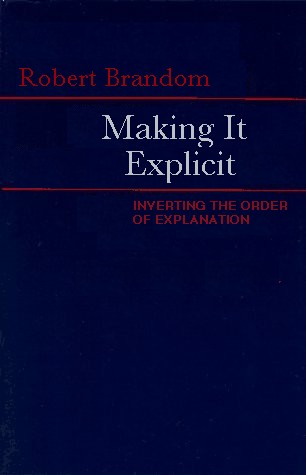
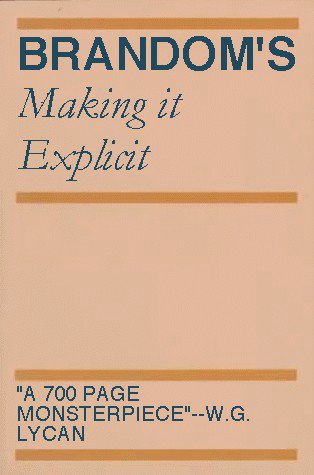
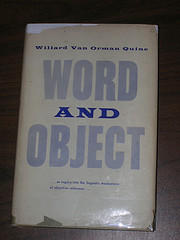
(I ripped off the idea for the cover on the left from John Haugeland, who made a cover for Making it Explicit based on the Norman Kemp Smith translation of the Critique of Pure Reason.)

Wednesday, October 19, 2005

Word and Object, Chapter One

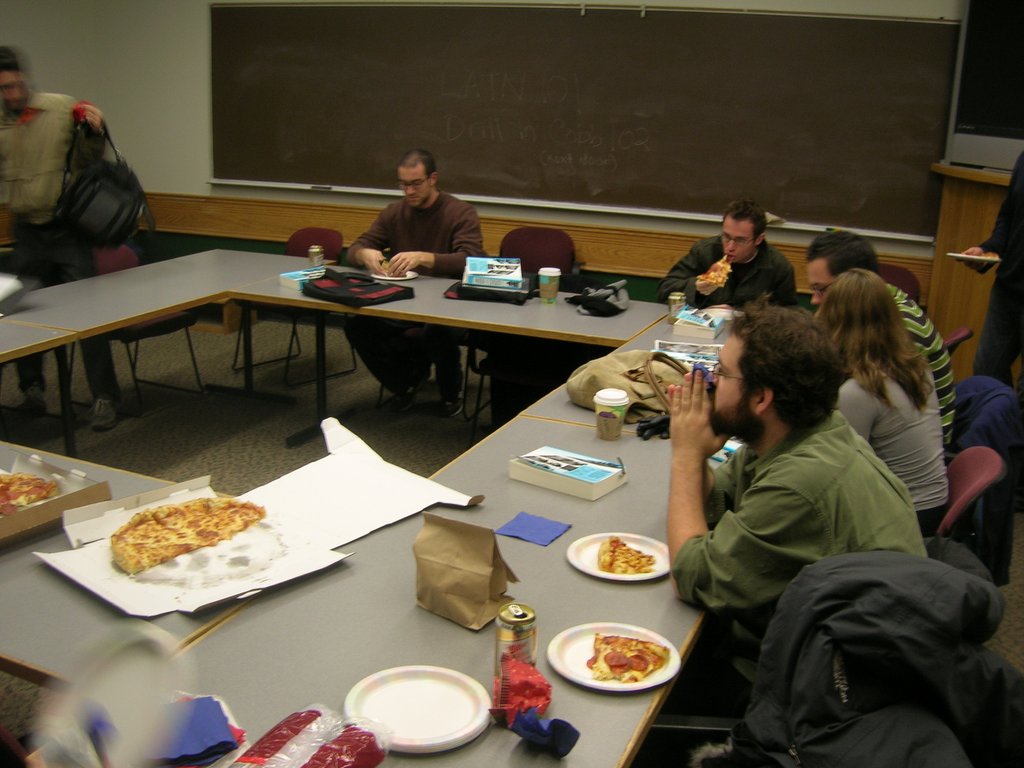
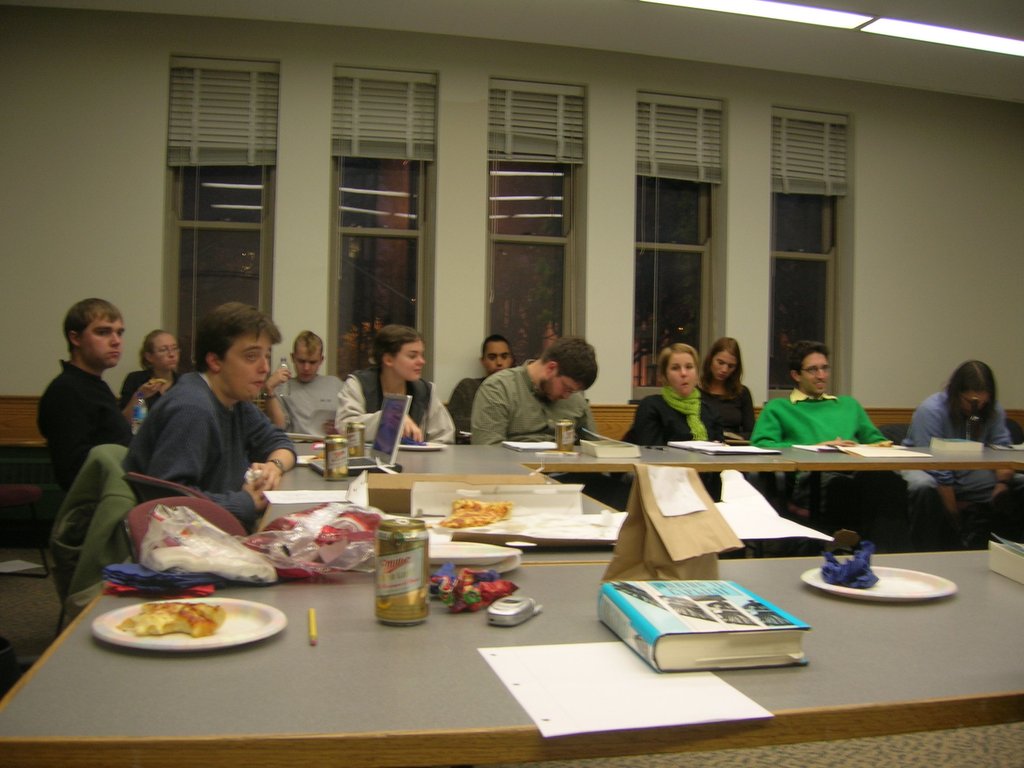
The promise of pizza, beer, and talk about whether philosophy is continuous with science drew the largest crowd in workshop history to Cobb 103 tonight.

Jason B. opened with a short introduction to some central Quinean themes: Naturalism, empiricism, stimulus meaning, holism, the social character of meaning, and meaning behaviorism. He introduced the familiar central worry about Quine's epistemology: how can surface irritations be "clues to an external world" (22)? My rough reconstruction of the central worry goes as follows:

1. For something to count as a clue, to count as evidence, it must be capable of justifying claims.
2. Only something with "content" (conceptual, propositional?) is capable of justifying claims.
3. Surface irritations have no content.
4. So surface irritations cannot count as clues, as evidence.

We started discussion by taking up the issue of Quine's naturalism. There was some debate about what it meant to say that philosophy and science were "continuous". Chris F. claimed that there was a difference between Quine's naturalism and physicalism of a type- or token-identity sort. Aidan G. said he liked science though he thought he wasn't supposed to. Chris F. said that people he has talked to in CHSS didn't see how it was possible to deny the "philosophy is continuous with science" claim. David F. observed that one could do it simply by saying that philosophy was discontinuous with science. For example, one might think, with the logical positivists, that the job of philosophy is to clear away conceptual confusion and let the scientists get on with their important work. Or one might think, with Wittgenstein, that the job of philosophy is to expose latent nonsense as patent nonsense.

So in response to the question, "Is philosophy continuous with science?" we concluded: it depends on what one means by "science" and "continuous with". No one asked what "philosophy" or "is" meant.

Nat H. asked about Quine's analogy between the sharing of "sensory supports" between sentences with the arch (p.11). How, when the arch is "tottering on an earthquake", is a "base block...supported now and again, only by the other base blocks via the arch"? Isn't the base block supported primarily by the ground? Jason B. pointed out that in asking this, Nat H. was neglecting Quine's footnote to the analogy, which says:

"The analogies of the fabric and the arch are well supplemented by the more detailed analogy of the net which Hempel develops..."

Several workshop participants (including, I believe, Tucker M.), explained that we were not supposed to imagine the ground dropping away from underneath the arch, in which case the other blocks clearly would not be of any help, but instead to imagine the ground merely shaking. In such a case one of the base blocks might be held in place by the weight of the other blocks pressing down on it. That sounded plausible.

Stina B. then asked for an explanation of how Quine's argument against sense data (pp. 2-3) was supposed to be understood. Was it merely a worry about memory, or something more significant? Chris F. said he was going to ask just the same question. David F. glossed the question as asking whether Quine comes close, in his criticism of sense data, to an insight that would have helped him detect the problems with his own account of sensory irritations. Quine's comment that "immediate experience simply will not, of itself, cohere as an autonomous domain" might be turned against his own notion that sensory stimuli count as the basic clues we have of the external world. Robert B. asked if David's proposal was part of a Resolute Reading of Word and Object.

Chris F. then recalled a possible reading of Quine from John H.'s class on Quine and Davidson five years ago. What if, Chris F. asked, Quine's sensory irritations were token identical with contentful experiences? The contentful experiences would be bound up with man's conceptual sovereignty, holistic, and so on, while the irritations, qua physical events, would remain unchanged through reconfigurations of the conceptual scheme. Jason B. objected that this wasn't consistent with Quine's statements that the irritations (qua irritations?), not conceptually contentful descriptions of the irritations, were supposed to be clues (cues?).

At this point, Chris F., the Dionysian force animating the workshop, had to leave to catch the beginning of Lost. So we wound up discussion and proposed that we read the preface and the first chapter of Making it Explicit for next week.

Quine on Maps and Dictionaries

In 1963, Quine wrote a review of the National Geographic Atlas of the World.

Here is an illustrative exerpt:

"I shall keep the old loose National Geographic maps for trips. And, since the National Geographic omits counties, I shall keep my old inferior book for counties. Grudgingly. It is before me now, a 1948 Hammond of even larger format than the National Geographic Atlas, and it is open at south central South America. The polychrome two-page spread is something between a poster and an imposture. Its detail is sparse and irresponsible. Part of Brazil is elaborately misplaced within Paraguay, and part of Paraguay in Argentina, as a glance at other pages bears out; the name of the Paranà is applied by mistake to the Iguassù, as well as to the Paranà; Aconcagua is omitted, though lesser mountains are marked; and two provinces of Chile are shown in a way that conflicts with another page. The 1954 Hammond is better, but I disagree. The point of my sad example is that such ineptitude is neither to be found nor imagined in National Geographic maps. They have an air somehow of selfevident accuracy, they are visibly as real as earth itself."

He also reviewed dictionaries.

Tuesday, October 04, 2005

Quine Reading

I have posted the first chapter of Word and Object to the workshop's e-reserve. It is listed as "Language and Truth".

Friday, September 30, 2005

Thursday, September 29, 2005

Plan for the Fall Quarter

Tonight we met to discuss the plan for the upcoming quarter.

Jason B. and David F. instituted some small, justified changes in the workshop format. These are: (1) Student presentations will take an hour, no more; (2) David and Jason will give short, 10-15 minute presentations at the beginning of each workshop.

Revision (1) met with no opposition, while Tom L. questioned whether (2) was possible given the garrulous character of the workshop participants. David F. and Jason B. responded by observing that they could defer questions until after they had finished lecturing if they felt like it.

In order to accommodate Jay E., we pushed the meeting time of the workshop back to 6pm.

We then discussed what text we should read. The one inviolable ground rule was that we had to read a book. Articles or collections of articles were out of bounds. David F. was in favor of reading the first four chapters of Making It Explicit. Nat H. Suggested Anscombe's Intention and Ryle's Concept of Mind; Chris F. suggested Fodor's Psychosemantics, Putnam's Representation and Reality, Kim's Mind in a Physical World, and Chalmer's Conscious Mind; Rachel G. suggested Quine's Word and Object, which turned out to be the closest competitor with the Brandom.

After a preliminary vote, we narrowed the field to the Brandom and the Quine, with Quine very slightly edging out the Brandom. We then decided to read the first chapter of each and only then decide what to continue with.

Next session we will read the first chapter of Word and Object. I will put a copy on E-Reserve at the library as soon as I can.

It was good to see everyone again.

Monday, September 26, 2005

Fall Quarter First Meeting

The first meeting of the philosophy of mind workshop will take place on Wednesday, September 28th in Cobb 103.

The agenda will be roughly the following:

1. What should we read?
2. What should we do with our money?
3. Should we begin each meeting with a student-lead introduction to the reading?
4. Should we / can we move the workshop to 6pm to accommodate Jay?

Monday, July 04, 2005

Philosophy of Mind In L.A.

While walking around the UCLA campus, guided by UCLA philosophy grad student Ben C., we spotted this salon:


I'd like to return and get the Dedekind cut.

Monday, June 13, 2005

Summer Vacation

The next meeting of the Philosophy of Mind Workshop (and the next full post to this site) will be in the first weeks of the fall quarter.

If I come across anything interesting I will post it as a comment to this entry. Feel free to do the same.

See everyone in the fall.

Tuesday, May 31, 2005

The Waterfall Illusion


On Thursday, May 26, Nate Z. presented his paper dismantling Crane's argument for non-conceptual content. Not only did Nate give good reasons to think Crane's argument doesn't go through, he also made some provocative claims about differences between the content of experience and the content of belief.

Jay E. provided his camera so we could document the last meething of the workshop this year, and the last meeting of the workshop in the Anscombe Lounge.

Below: Nate Z. demonstrates the sprial version of the waterfall illusion.


Justin S., Rachel G. and Aidan G. are transfixed by the illusion.


David F. taxis down the runway.


Jason B. makes a claim and David F. looks on in despair.


Nat H. in the Logical Positivism shirt: Cruisewear for Neurath's Boat.


Nate Z. reads his paper.


Farewell to the Lounge.

Monday, May 23, 2005

The Standard Meter Bar

standard meter bar
standard meter bar,
originally uploaded by Nat Hansen.
This is the American standard meter bar. I didn't expect it to look like this--I thought it would look like a meter ruler (with centimeter marks, e.g.) but, you know, made of platinum.

Below is the picture of the similar looking French standard meter bar (together with a standard kilogram). Thanks to an anonymous commentator for the reference.